


Today we had a fascinating discussion about the US school system with Jim De George, probably one of the best, most thoughtful, teachers I have had the pleasure of being taught by. There were so many things we talked about today that I could comment on but it was the comment of one of my colleagues, Dimona Yaniv, which most struck me. She spoke about the “space between teaching and learning.”
That idea struck me as so important, perhaps even a core of what we do as teachers. The “space” can be interpreted in two ways – first, as a gap between what we think we are communicating and what our students actually get. There is of course always that gap between signifier and signified, between my mind and yours, between our perception and experience of the world. As teachers, though, we have a special duty to narrow that gap as much as possible. We may not be able to bridge it but perhaps we can make it narrow enough that a spark of inspiration can cross it.
So how do we narrow the gap? I’m sure there are many ways, amongst which must be trying to understand our kids as individuals, as human and full people, to interact with them in the spirit of ubuntu. To me, though, the most important thing is that we must be human too. We cannot hope to gain the attention of our students if we are dragons, automatons, aliens. A small personal story, an opinion, a sense of humour: these are the things that can draw students in and allow the spark to cross the gap.
Dimona herself sees the space as a place of positivity, of possibility: the something that happens between a teacher or counsellor and a student that allows real, meaningful conversation to take place. This thing is ephemeral, indefinable, unmeasureable but all the more important because of this. This positive space is the second interpretation of the space. I have found and used that space a few times in my career – far too few – and it is a magical experience when it happens. A student previously disinterested, perhaps even destructive transforms into something wonderful. No, not transforms, for neither teacher nor student changes – perhaps a better word is ‘unfolds’. You see a plane of the learner you had not seen before or perhaps had just not recognised to be there.
This year I have had the privilege of experiencing this unfolding with one of my learners and I have been thinking about her for much of the day. A grade 12 learner, she had seldom showed much interest in class. And then we started looking at the Black Power movement in the USA. Something sparked, we tumbled into the space. Perhaps it was my strange attraction to Malcolm X that did it, perhaps it was a resonance with the idea of being self-sufficient, proud and strong. I may never know. A plane opened up and quite suddenly I had an involved learner on my hands, who challenged ideas, asked questions, made the most astounding extrapolations. I saw (perhaps she too saw) for the first time a budding young academic with a fierce intellect and burning passion.
Of course, passion and intellect must be fed and nurtured and this particular experience of the space is bitter-sweet for me. Leaving South Africa meant I left many things behind – family, kittens, friends, partner, inspiring colleagues, good chocolate – but I’ll be going back to those things. The only thing I feel really guilty about is leaving this learner, this fragile bloom of a young mind. So from half way across the world I hope that she is reading, drinking in the learning that could make her into something truly special and deeply needed in our country – an active, involved, critical citizen. Regardless, I am proud of her and I know that she will continue to make me proud.

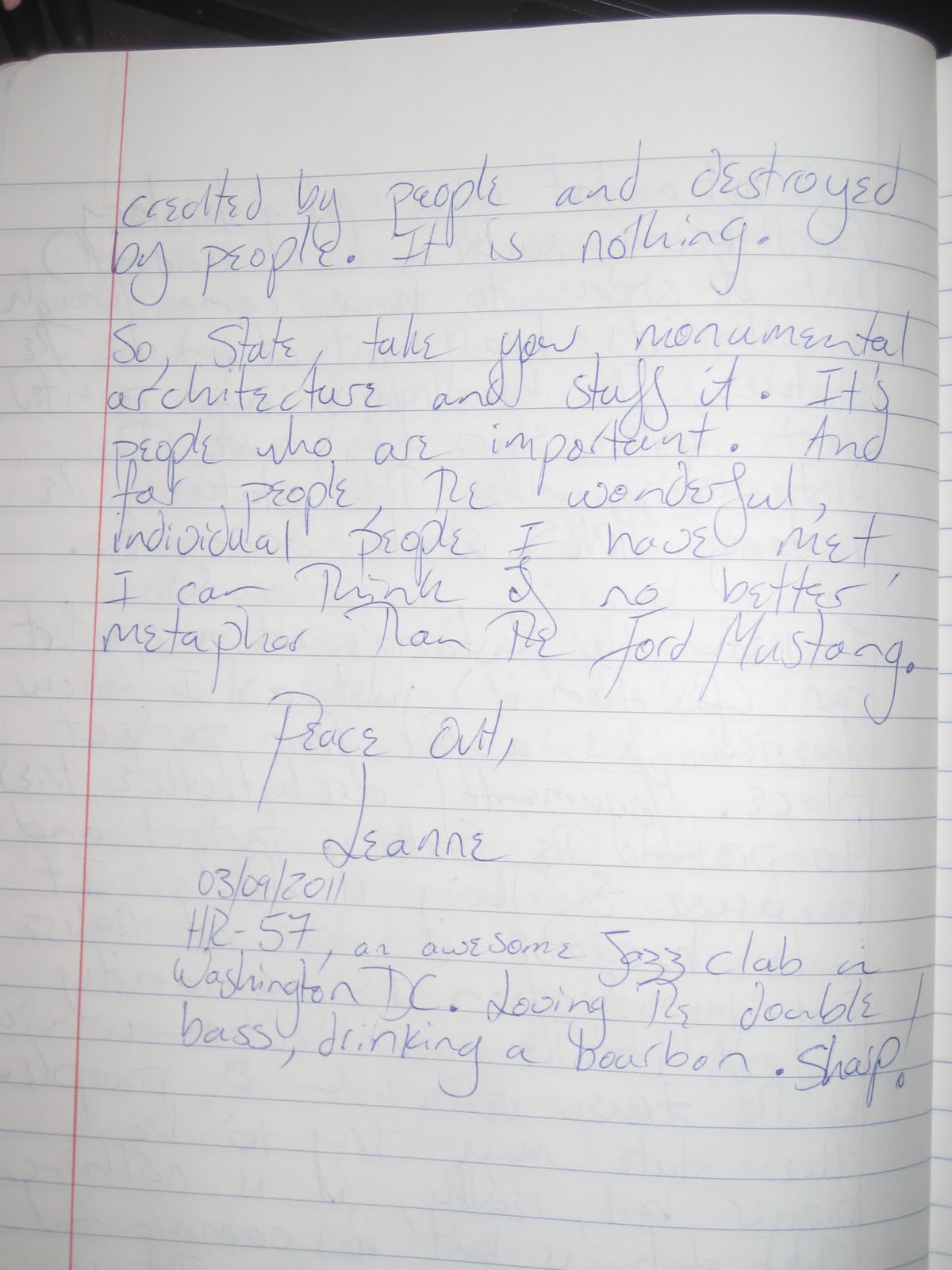
Maya Lin’s memorial is a question more than anything else – it REMEMBERS but does not impose a specific morality on the viewer. Of course, you could argue that the mere existence of the memorial glorifies war and imposes the moral, “dulce et decorum est pro patria mori.” Conversely, the massive list of names could be viewed as an indictment of war. Ambiguity. I don’t think a memorial is significant JUST because of ambiguity – but in this specific case, when opinions about the war are themselves so divided and ambiguous, it seems particularly fitting. Where in another monument ambiguity could be seen as a failure, here I think it is one of the greatest successes.

Many Vietnam Vets vehemently disagreed with the monument, at least partly because of its ambiguity. They wanted a monument which reflected their views on the war, their experiences and their trauma. Maya Lin was adamant that the piece remain simple. And thus a monumental debate was raised. I see this as a second [most probably unintentional] success of the memorial. I believe that debate about the way we remember our past – indeed debate about whether “we” should remember some collective fable of “our” past at all – is an essential part of memorialisation. This importance is twofold – first, it keeps the memory active. Second, it questions the aims of memorialisation.
The former is important to counter the tendency to allow stone to take the burden of memory (an idea in James Young’s Texture of Memory) and thus make it inactive. When there is debate, it forces a society to confront the event being remembered, to be active in their treatment of it. I also think that it forces people to confront uncomfortable aspects of the event. In this case, it allowed for a deeper understanding about the needs of Veterans and dialogue around opinions on war. I admit I am no expert and so I’ll qualify the previous statements with a, “please comment.”
The latter importance is one I am more comfortable confronting. Again I think this was unintentional, but Lin’s structure and the controversy surrounding it raise an important question for the Heritage sector: WHO do we build memorials for? Here the Veterans and many others felt the memorial was for them, and should thus reflect their views. It should be a patriotic memorial – this led to the creation of an ancillary monument of the more literal variety which in my opinion is far less effective than the original.

Lin and others saw memorialisation in a broader light and I fall into that camp. I think that a memorial must be for a [the?] public and must recognise a range of existing opinion. Its aim should be to challenge and question opinions, to make the viewer look inwards. I fear monuments which impose a viewpoint as the outward, concrete manifestations of dangerous nationalist historiography. In this way I think Lin’s memorial is excellent – it is remembrance and it is for Remembrance.

Lists of names attract me. I like that individuals are acknowledged rather than being subsumed into an essentialised soldier – not unknown exactly; more undifferentiated. I also like that the list of names slows the viewer down – you cannot take it all in at once. There is no way to glance and move on. A name catches your eye, you read it, you read the next, you are drawn into this devastating list of loss. Although you probably have no connection to the person behind the name other than our common humanity, for a moment you ARE the monument. Aloud or sub-vocally, you say his name. Those syllables attach themselves to you, bring the lost a micron closer. In that moment you link to history. Perhaps you glimpse fear, suffering, bravery, sacrifice, brutality, innocence; you do grasp humanity. You may run your fingers along the names, trying to gain some physical link to this foreign past. Regardless of your views of war in general, or the Vietnam War itself, I think you cannot fail to empathise with, feel for, that name you read, that individual. For me at least, a list like the one on this memorial allows me to separate an abhorrence of war and war-makers from a respect and honour for individual [mostly drafted] soldiers.

The stone of the memorial is black, highly polished, reflective. This reflection is to me an important success of the memorial. Whenever you look at a name you are forced to look at yourself. As you look at the past, you also look at the present. Just as there is no way to glance unseeing at the names, you cannot separate yourself from the monument. There is a powerful message here about the impact of the past on the present and about the way the present impacts on how we view and represent the past.
It is this forced interaction, forced debate, forced thought, forced reflection on the fables we create of our past that I think are so effective about Lin’s design. This is no static stone – it is a question which each viewer answers and answers anew at each viewing.


